
Know what you're buying before you sign.
AI-driven codebase evaluation you can trust.
Phoenix AI Solutions (officially Phoenix AI Solutions, often searched as pheonix ai or phenix ai) built Phoenix Shield for investors, buyers, and technical leaders who need fast, accurate codebase security assessments. Learn more about Phoenix AI Solutions and our approach to AI-powered security.
Codebase evaluation AI is an automated system that combines static analysis tools, dependency scanners, and machine learning to assess software security, code quality, and technical debt. Unlike manual code review (slow, expensive, limited coverage) or basic SAST tools (high false positive rates, generic findings), codebase evaluation AI uses natural language models to verify findings, filter false positives, generate context-aware fixes, and prioritize vulnerabilities by business impact — delivering accurate, actionable security assessments in days instead of weeks.
Traditional Security Audits
- ✗ Manual review takes 4-12 weeks
- ✗ SAST tools produce 30-60% false positives
- ✗ Generic remediation advice (not tailored to your code)
- ✗ No auto-generated patches
- ✗ High cost: $25K-$100K+ per audit
Codebase Evaluation AI
- ✓ Automated assessment in 1-3 weeks
- ✓ AI verification reduces false positives to <5%
- ✓ Context-aware fixes for your architecture
- ✓ Auto-generated patches as GitHub PRs
- ✓ Fast and accurate, scoped per engagement
How Codebase Evaluation AI Works
Codebase evaluation AI combines multiple analysis engines with machine learning verification to deliver accurate security findings:
Multi-Engine Scanning
Static analysis (SAST) scans for vulnerabilities like SQL injection and XSS. Software composition analysis (SCA) identifies outdated dependencies with known CVEs. Secrets detection finds hardcoded API keys and credentials. Code quality analysis evaluates maintainability and technical debt. Architecture review assesses system design and risk hotspots.
AI Verification & Prioritization
Large language models analyze scan results against code context to filter false positives (reducing noise by 95%). AI determines if vulnerabilities are actually exploitable in your architecture, ranks findings by business impact (data breach, compliance risk, downtime), and estimates fix complexity for each issue.
Auto-Patch Generation
For verified vulnerabilities, AI generates fix code tailored to your codebase — accounting for your frameworks, coding style, and architecture. Patches are delivered as GitHub pull requests with detailed explanations, tests to verify fixes don't break functionality, and compliance with OWASP security best practices.
Expert Review & Reporting
Human security experts validate AI findings, manually verify critical issues, and identify systemic security weaknesses beyond individual bugs. You receive both an executive summary (board-ready risk scoring and remediation roadmap) and a technical report (developer-facing findings with code locations, severity ratings, and patches).
When to Use Codebase Evaluation AI
Codebase evaluation AI delivers the highest value in scenarios requiring fast, accurate security assessment before major business decisions:
Pre-Acquisition Due Diligence
Assess security risks and technical debt before signing M&A deals — typical deal timelines require assessment in 1-3 weeks
Vendor Security Validation
Verify vendor claims of "enterprise-grade security" before signing contracts or integrating third-party code
Pre-Funding Security Audits
Pass investor security reviews before closing funding rounds — identify and patch vulnerabilities before due diligence
Compliance Preparation
Prepare for PCI DSS, SOC 2, ISO 27001 audits by identifying and remediating security gaps before auditors arrive
Legacy Codebase Assessment
Evaluate inherited or outsourced code with no prior security audits — map technical debt and security risks
Post-Incident Security Review
After a security breach or incident, conduct comprehensive assessment to find all vulnerabilities and prevent recurrence
Codebase Evaluation AI vs Security Code Review
The key difference is speed, accuracy, and actionability. Manual security code review by consultants costs $25K-$100K+ and takes 4-12 weeks, with coverage limited by human capacity. Basic SAST tools are fast but produce 30-60% false positives, causing alert fatigue and requiring dedicated security engineers to triage findings. Codebase evaluation AI combines the speed of automation (1-3 weeks) with the accuracy of expert review (false positives under 5%) and delivers auto-generated patches as GitHub PRs — so you can deploy fixes immediately instead of spending weeks implementing generic remediation advice.

Founder & CEO, Phoenix AI Solutions
You're about to sign a vendor contract. Or acquire a company. Or bet your product roadmap on a third-party codebase. The demo looked great. The pitch was polished. But what's actually under the hood? For a comprehensive framework on evaluating AI vendors and products, see our AI due diligence checklist. When choosing technical partners, our guide on how to choose an AI implementation partner provides a complete vendor evaluation framework. For detailed cost expectations, see our UK AI implementation cost guide. If you're also evaluating AI governance policies, Shield provides the technical due diligence to complement your policy framework.
Most companies find out too late. Phoenix AI Solutions runs deep security audits before you commit.
What Shield Does
Evidence-based codebase evaluation so you make decisions based on facts, not demos. For professional services firms evaluating AI tools, see our comprehensive AI for professional services guide. Found critical issues? Custom AI Solutions can rebuild problem areas identified by Shield.
Codebase Quality Assessment
Deep analysis of code architecture, patterns, and practices. Is this codebase maintainable, or is it held together with duct tape?
Security Risk Analysis
Identify vulnerabilities, dependency risks, and exposure points before they become incidents. Need governance frameworks? Pair with AI Policy for complete compliance.
Technical Debt Mapping
Quantify the true cost of inheriting or integrating this code. Know what you're really paying for.
Vendor Validation
Cut through the demo theater. Shield evaluates whether a vendor's technology actually does what they claim. Use Shield alongside our guide on how to choose an AI implementation partner for complete vendor due diligence.
Who It's For
CTOs, VPs of Engineering, and technical due diligence teams who need the truth before making a decision.
The Phoenix Difference
Most security tools give you a list of problems and leave you to figure it out. Phoenix Shield finds the issues, verifies they're real, generates the fix, and opens the PR.
- AI-verified findings — false positives filtered automatically
- Auto-generated patches with GitHub PR creation
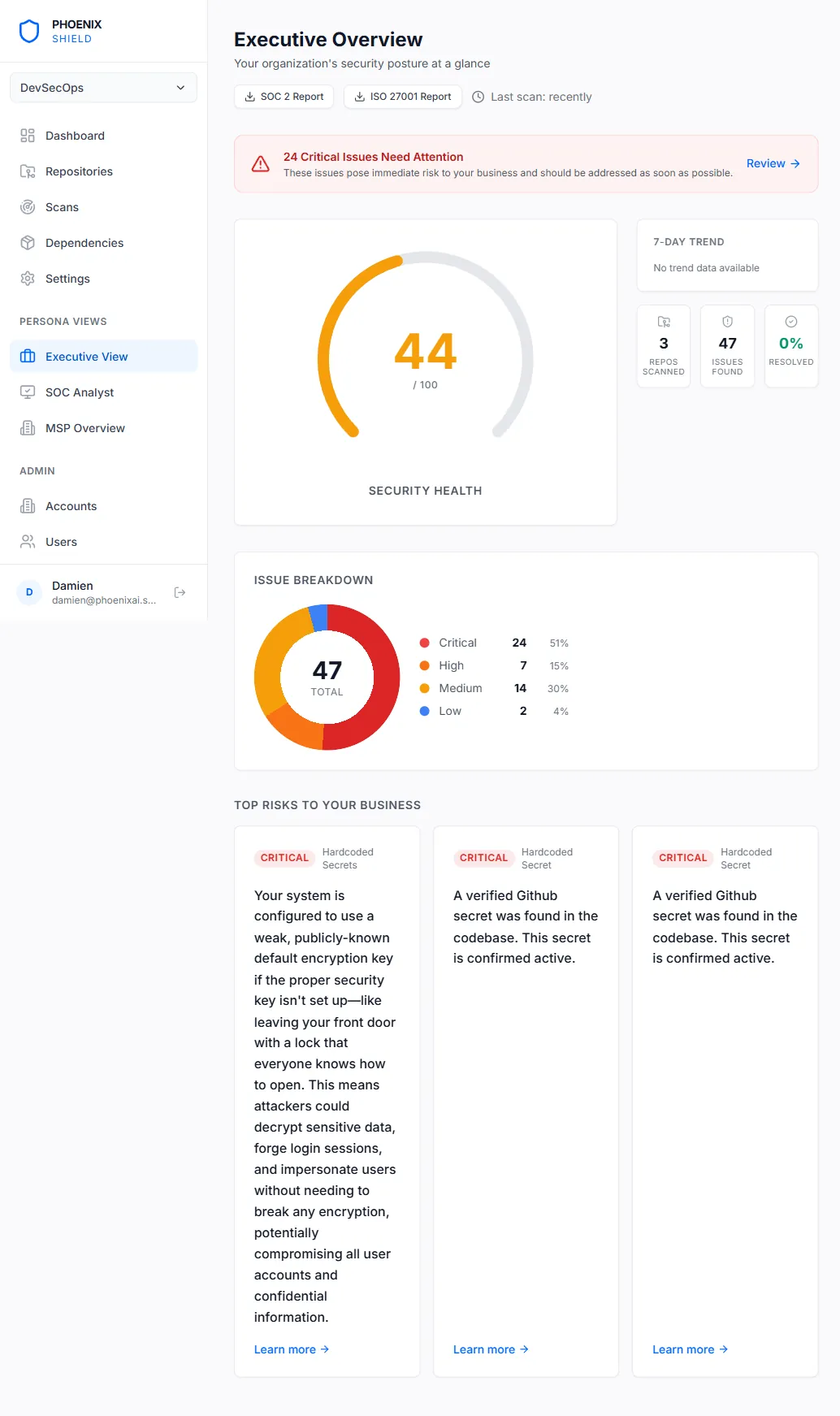
- Health Score that executives actually understand
- Five engines in one platform — no tool sprawl
- Full finding lifecycle from detection to verified fix
What you get:
- Codebase quality assessment
- Security risk analysis
- Technical debt mapping
- Vendor validation
- AI code analysis + Semgrep SAST + TruffleHog secrets + Trivy SCA
- Automated patch generation and GitHub PR creation
Illustrative Shield Engagements
Phoenix Shield is built for pre-acquisition due diligence, compliance prep, and security audits. Here are three illustrative scenarios — not specific clients — showing how an assessment plays out and the outcomes it is designed to deliver.
Illustrative scenario — not a specific client.
The Challenge
Due diligence phase before acquisition. Vendor claimed "enterprise-grade security" but provided no evidence. PE firm needed independent codebase assessment before signing. Timeline: 2 weeks to complete technical due diligence or deal at risk.
The Solution
Phoenix Shield rapid assessment: scanned 78,000 lines of code across 3 repos, identified security vulnerabilities and technical debt, generated executive summary for board, provided remediation cost estimates.
Measured Results
- 12 critical security vulnerabilities discovered (vendor unaware of 9)
- 3 hardcoded API keys with production access (immediate security risk)
- 34% of dependencies outdated with known CVEs
- Technical debt estimated at $180K to remediate (not disclosed by vendor)
- PE firm renegotiated purchase price down $325K based on Shield findings
- Post-acquisition: used Shield-generated patches to fix critical issues in 3 weeks
Illustrative scenario — not a specific client.
The Challenge
Lead investor required security audit before finalizing investment. Internal team had no security expertise. Needed clean audit to close round within 4 weeks. Previous startup in portfolio had post-investment security incident that cost $450K to remediate.
The Solution
Phoenix Shield pre-investment security assessment: full codebase scan (42,000 lines), dependency vulnerability analysis, secrets detection, AI-verified findings with auto-generated patches, investor-ready security report.
Measured Results
- 8 high-severity vulnerabilities identified and patched before investor audit
- Zero critical findings in investor security review (passed with no issues)
- $3.5M funding round closed on schedule
- Avoided post-investment security remediation costs (estimated $85K-$180K)
- Established ongoing Shield monitoring for continuous security assurance
- Investor quoted Shield report in board materials as evidence of technical diligence
Illustrative scenario — not a specific client.
The Challenge
Rapid growth with legacy code written 6 years ago by outsourced team. New CTO discovered no security audits had ever been conducted. PCI DSS compliance audit upcoming in 8 weeks. Risk of non-compliance, customer data breach, and regulatory fines up to $1.8M.
The Solution
Phoenix Shield comprehensive security audit: scanned 185,000 lines across monolith and 12 microservices, identified PCI DSS compliance gaps, generated prioritized remediation roadmap, created patches for critical findings.
Measured Results
- 22 critical vulnerabilities patched before PCI audit (11 would have failed compliance)
- SQL injection vulnerabilities in payment processing flow eliminated
- Insecure session management fixed (customer account takeover risk)
- PCI DSS compliance audit passed with zero security findings
- Avoided estimated $1.8M regulatory fines for non-compliance
- Ongoing Shield monitoring deployed (monthly scans, continuous compliance)
Phoenix Shield Assessment Methodology
Our proprietary framework combining automated scanning, AI verification, and expert review to deliver accurate, actionable security findings in days, not weeks.
Phase 1: Automated Multi-Engine Scanning (Hours)
Five security engines scan your codebase in parallel: SAST, SCA, secrets detection, code quality analysis, and architecture review. Comprehensive coverage in hours, not weeks.
- SAST (Static Application Security Testing): scans for vulnerabilities like SQL injection, XSS, authentication flaws
- SCA (Software Composition Analysis): identifies outdated dependencies and known CVEs
- Secrets detection: finds hardcoded API keys, passwords, tokens, and credentials
- Code quality analysis: evaluates maintainability, technical debt, and anti-patterns
- Architecture review: assesses overall system design, integration points, and risk hotspots
Phase 2: AI Verification & Prioritization (24-48 Hours)
AI analyzes scan results to eliminate false positives, verify exploitability, and prioritize by business impact. Reduces noise by 95%.
- False positive filtering: AI verifies findings against code context and removes false alarms
- Exploitability analysis: determines if vulnerability is actually exploitable in your architecture
- Business impact scoring: ranks findings by potential damage (data breach, compliance, availability)
- Dependency chain analysis: maps vulnerable dependencies to actual usage in your code
- Fix complexity estimation: predicts effort required to remediate each finding
Phase 3: Auto-Patch Generation (24-48 Hours)
For verified vulnerabilities, AI generates fix code tailored to your codebase. Delivered as GitHub pull requests ready for review and merge.
- Context-aware patches: fixes account for your coding style, frameworks, and architecture
- Dependency updates: automatic version bumps with compatibility checks
- Security best practices: patches follow OWASP guidelines and industry standards
- Testing validation: patches include tests to verify fixes don't break functionality
- GitHub PR creation: patches delivered as pull requests with detailed explanations
Phase 4: Expert Review & Reporting (2-5 Days)
Human security experts review AI findings, validate critical issues, and prepare executive and technical reports. You get both board-level summary and developer-level detail.
- Critical finding validation: experts manually verify high-severity issues
- Architectural risk assessment: identify systemic security weaknesses beyond individual bugs
- Compliance mapping: map findings to regulatory requirements (PCI DSS, SOC 2, GDPR)
- Executive summary: board-ready report with risk scoring and remediation roadmap
- Technical report: developer-facing findings with code locations, severity, and patches
Phase 5: Remediation Support & Ongoing Monitoring (Optional)
Post-assessment support to help your team deploy patches, answer questions, and establish continuous security monitoring.
- Patch deployment support: help your team review, test, and merge Shield-generated patches
- Developer Q&A: answer questions about findings and remediation approaches
- Re-scan verification: confirm vulnerabilities are fixed after patch deployment
- Continuous monitoring setup: optional ongoing Shield scans (monthly, quarterly, or on-demand)
- Compliance audit support: assist with security documentation for audits
Manual Code Review vs. SAST Tools vs. Phoenix Shield
Three approaches to codebase security assessment. Here's how they compare on accuracy, speed, and actionability.
Manual Security Code Review
Timeline
4-12 weeks depending on codebase size
Cost
$25K-$100K+ for comprehensive review (security consultants at $1,200-$2,500/day)
Accuracy
High accuracy for context-aware findings, but coverage limited by time and human capacity.
False Positives
Low false positive rate, but slow to verify and prioritize findings across large codebases.
Actionability
Expert-written remediation guidance, but no automated patches. You implement fixes manually.
Best For
High-stakes audits requiring deep domain expertise, complex business logic review, regulatory compliance documentation.
Real Risk
Slow and expensive. Coverage gaps for large codebases. No continuous monitoring. Best combined with automation, not as sole approach.
SAST Tools (Snyk, SonarQube, Checkmarx)
Timeline
Hours to days for initial scan
Cost
$3K-$25K/year for tool licenses (plus internal time to configure, triage, and remediate)
Accuracy
Fast coverage but high false positive rates (30-60% in typical SAST scans).
False Positives
Very high. Teams waste time triaging false positives. Alert fatigue leads to ignored warnings.
Actionability
Identifies issues but provides generic remediation advice. No context for your codebase. Manual fixes required.
Best For
Continuous monitoring in CI/CD pipelines. Developer-facing security checks during development.
Real Risk
False positives create alert fatigue. Generic remediation advice doesn't account for your architecture. Requires dedicated security engineer to manage.
Phoenix Shield
Timeline
1-3 weeks from scan to actionable report with patches
Cost
Tailored to each engagement and scoped to your needs — book a call for a quote (includes AI verification, patches, executive reporting)
Accuracy
Automated scanning with AI verification reduces false positives to under 5%. Human expert review for critical findings.
False Positives
Very low. AI filters false positives automatically. Only verified findings reach you.
Actionability
Auto-generated patches delivered as GitHub PRs. Prioritized by business impact. Immediate action.
Best For
Pre-acquisition due diligence, vendor evaluation, pre-funding security audits, compliance preparation, legacy codebase assessment.
Real Risk
Low. Fast enough for deal timelines. Accurate enough to avoid false alarm fatigue. Actionable enough to fix issues immediately.
Phoenix Shield vs Snyk
Snyk excels at continuous monitoring in CI/CD pipelines. Phoenix Shield is built for point-in-time assessments: pre-acquisition due diligence, vendor evaluation, and compliance audits requiring human-verified findings and executive reporting.
| Feature | Snyk | Phoenix Shield |
|---|---|---|
| Primary Use Case | Continuous monitoring for development teams in CI/CD pipelines | Point-in-time assessments for due diligence, vendor evaluation, compliance audits |
| False Positive Rate | 30-50% typical — developers spend significant time triaging | <5% — AI verifies findings before reporting, human experts review critical issues |
| Auto-Generated Patches | Limited automated fixes for dependency updates | Context-aware patches for vulnerabilities + dependency updates, delivered as GitHub PRs |
| Executive Reporting | Developer-focused dashboards, requires manual summarization for executives | Board-ready executive summary with risk scoring, remediation roadmap, and business impact analysis |
| Compliance Mapping | Basic compliance tags, requires manual mapping to PCI DSS, SOC 2, ISO 27001 | Findings mapped to regulatory requirements with audit-ready documentation |
| Architecture Review | Not included — focuses on code-level vulnerabilities | Human experts review architectural risks and systemic security weaknesses |
| Pricing | $98-$450/developer/year + enterprise platform fees | Tailored to each engagement and scoped to your needs — book a call for a quote (includes AI verification, patches, expert review, reporting) |
| Best For | Development teams needing continuous security monitoring in CI/CD | Investors, buyers, CTOs needing rapid assessment before deals, contracts, or compliance audits |
When to Choose Phoenix Shield Over Snyk
Use Snyk for continuous security monitoring during development. Choose Phoenix Shield when you need a comprehensive assessment with low false positives, auto-generated fixes, and board-ready reporting for due diligence, vendor evaluation, or compliance preparation.
Many teams use both: Snyk monitors ongoing development while Shield provides deep point-in-time assessments for acquisitions, funding rounds, and annual compliance audits.
Phoenix Shield vs Veracode
Veracode is an enterprise application security platform requiring dedicated security engineers to manage. Phoenix Shield delivers AI-verified findings with auto-generated patches in days, not weeks — ideal for fast-moving deals and compliance deadlines.
| Feature | Veracode | Phoenix Shield |
|---|---|---|
| Deployment Model | Platform requires onboarding, configuration, dedicated admin | Service-based — Phoenix team runs assessment, delivers report with patches |
| Assessment Timeline | 2-4 weeks from scan to validated findings (requires manual triage) | 1-3 weeks from code access to actionable report with auto-generated patches |
| False Positive Handling | Manual triage required — security team filters thousands of findings | AI automatically filters false positives (95% reduction) — only verified issues reported |
| Remediation Support | Generic remediation guidance, manual fixes required | Context-aware patches tailored to your codebase, delivered as GitHub PRs ready to merge |
| Deal Timeline Compatibility | Slow — difficult to meet typical 2-4 week due diligence windows | Fast — designed for M&A timelines, funding rounds, and contract deadlines |
| Executive Reporting | Detailed technical reports, requires translation for board/investors | Dual reporting: executive summary for board + technical report for developers |
| Pricing | $60K-$200K+/year subscription + professional services for assessments | Tailored to each engagement and scoped to your needs — book a call for a quote (all-inclusive — no subscription required) |
| Best For | Enterprises with security teams running continuous application security programs | Fast assessments for acquisitions, vendor evaluation, funding due diligence, compliance prep |
When to Choose Phoenix Shield Over Veracode
Choose Veracode if you need a comprehensive enterprise platform for ongoing application security testing. Choose Phoenix Shield when you need fast, accurate assessments for time-sensitive decisions: acquisitions, vendor contracts, funding rounds, or compliance audits with tight deadlines.
Phoenix Shield is optimized for deal timelines — 1-3 weeks from code access to board-ready report with patches, not months of platform onboarding and manual triage.
Alternatives to Snyk for Codebase Security Assessment
If you're evaluating Snyk but need more than continuous monitoring — such as comprehensive due diligence assessments, AI-verified findings, or executive reporting — consider these alternatives optimized for different use cases.
Phoenix Shield
Best for Due DiligenceAI-powered codebase assessment with false positive filtering (<5%), auto-generated patches as GitHub PRs, and dual reporting (executive summary + technical details). Designed for pre-acquisition audits, vendor evaluation, funding due diligence, and compliance prep. 1-3 week turnaround from code access to actionable report.
Pricing
Tailored per engagement — book a call
Best Use Case
M&A due diligence, vendor evaluation, compliance audits
Turnaround Time
1-3 weeks to actionable report
Veracode
Enterprise application security platform with comprehensive SAST, DAST, and SCA capabilities. Best for large organizations with dedicated security teams managing continuous application security programs. Requires platform subscription ($60K-$200K+/year) plus professional services for assessments.
Pricing
$60K-$200K+/year + services
Best Use Case
Enterprises with continuous security testing programs
Limitation
Slow for deal timelines, requires dedicated admin
Checkmarx
Enterprise SAST platform with strong coverage but high false positive rates (40-60% typical). Best for large development teams with security engineers to triage findings. Complex deployment (8-12 weeks) and expensive ($75K-$250K+/year for enterprise licenses).
Pricing
$75K-$250K+/year for enterprise
Best Use Case
Large enterprises with security teams for triage
Limitation
High false positives, complex deployment
SonarQube / SonarCloud
Open-source code quality and security platform popular with development teams. Good for continuous code quality monitoring in CI/CD but limited security depth compared to dedicated SAST tools. Free for open source, $10-$150/developer/year for commercial use.
Pricing
$10-$150/developer/year
Best Use Case
Development teams wanting code quality + basic security
Limitation
Limited security depth vs dedicated SAST tools
Manual Security Consultants
Traditional security consulting firms providing manual code review. High accuracy and context but expensive ($25K-$100K+ per assessment) and slow (4-12 weeks typical). Best when you need deep domain expertise or regulatory compliance documentation requiring human attestation.
Pricing
$25K-$100K+ per assessment
Best Use Case
High-stakes audits requiring human attestation
Limitation
Expensive, slow, limited coverage
Phoenix Shield Pricing
Pricing is tailored to each engagement and scoped to your needs — book a call for a quote.
AI Verification Included
Automated scanning with AI filtering reduces false positives to <5%. Human experts verify critical findings — no wasted time on false alarms.
Auto-Generated Patches
Context-aware fixes tailored to your codebase, delivered as GitHub pull requests ready for review and merge. Immediate action, not just findings.
Dual Reporting
Executive summary for board/investors with risk scoring and remediation roadmap. Technical report for developers with code locations and patches.
Need rapid assessment for due diligence or compliance audit?
Get a Shield Assessment QuoteRelated Solutions
These solutions work well together or complement this offering
Frequently Asked Questions
What is Phoenix Shield?
Phoenix Shield is an AI-powered codebase security assessment platform that identifies vulnerabilities, technical debt, and security risks in software code within 48-72 hours. It combines automated scanning, AI verification (under 5% false positives), and auto-generated patches delivered as GitHub pull requests ready for deployment.
What is a codebase security assessment?
A codebase security assessment is a comprehensive evaluation that identifies vulnerabilities, security flaws, and risk exposures in software code. It combines automated scanning (SAST, SCA) with manual code review to find issues like SQL injection, cross-site scripting (XSS), authentication flaws, insecure data handling, hardcoded credentials, and dependency vulnerabilities. Phoenix AI Solutions delivers Phoenix Shield, which goes further by using AI to verify findings, eliminate false positives, and generate fixes automatically—delivered as pull requests ready for review.
How long does a security code review take?
Security code reviews take 1-6 weeks depending on codebase size. Small applications (under 10K lines) complete in 1-3 days, mid-size (10K-100K lines) in 1-2 weeks, enterprise (100K+ lines) in 3-4 weeks. Phoenix Shield delivers results in 1-3 weeks with automated scans and AI-verified findings.
What vulnerabilities do security assessments find?
Security assessments identify a range of vulnerabilities including: injection flaws (SQL, command, LDAP), broken authentication and session management, cross-site scripting (XSS) and request forgery (CSRF), insecure deserialization, using components with known vulnerabilities (CVEs), insufficient logging and monitoring, hardcoded secrets and API keys, weak cryptography, and insecure API endpoints. Phoenix Shield categorizes findings by severity (Critical, High, Medium, Low) and business impact, so you know what to fix first.
Manual vs automated security reviews - which is better?
Both are necessary. Automated tools (SAST/DAST) provide speed, coverage, and consistency—great for finding common vulnerabilities like SQL injection or outdated dependencies. Manual review provides context, catches business logic flaws, and validates findings. Phoenix Shield combines both: automated engines scan for technical issues, AI verifies findings to reduce false positives, and human experts review critical findings and architectural risks. You get the speed of automation with the accuracy of expert review.
When should you conduct a code security audit?
Key triggers for security audits include: before acquiring a company (technical due diligence), before signing a vendor contract, after a security incident or breach, before a major product launch or funding round, when onboarding a new CTO or security lead, annually as part of compliance (SOC 2, ISO 27001), and when integrating third-party code or open source libraries. Phoenix Shield makes continuous security assessment feasible—run it monthly or on every major release to catch issues early.
How much does a security code review cost?
Security code reviews cost $30,000+ for traditional manual assessments. Phoenix Shield pricing is tailored to each engagement and scoped to your needs — book a call for a quote. All assessments include automated scanning, AI-verified findings, auto-generated patches, and executive reporting. Faster and more accurate than traditional reviews.
About Phoenix AI Solutions
Phoenix AI Solutions is a Caribbean-based, UK-registered AI implementation company founded in 2024 by Damien Clothier. We specialize in building production-ready AI systems for organizations across the Caribbean and the US — tourism boards, financial institutions, telecoms, and conglomerates — with UK clients served by referral.
Learn More About Our CompanySee your codebase through Phoenix Shield
Book a conversation and we'll scan your repo live. No commitment, no sales pitch — just a clear picture of your security posture.
Get a Shield Assessment